Showing posts with label C. S. Lewis. Show all posts

Monday, August 12, 2013

Hello Old Friends

I was working on my deck Friday. The weekend was nearly here and I was wrestling with a software fault with my head down. I heard a clunk and looked up to see my wife, Mary, had dumped a box of books off the edge of the deck into the grass. I didn't appreciate the disrespect with which they had been treated but I understood why.

The box had sat next to the furnace in my basement and collected a little dust in the several years it resided there. Before that, it sat for many years next to the furnace in my father's basement. I should say furnaces, because while the box resided in Dad's basement, he had a coal-fired furnace, a natural gas furnace, and a wood-fired furnace. Between the coal and wood smoke the box was well sooted.

Dumping the box's contents into the lawn was the first step in removing the cobwebs, dust, and soot from my books. There was such an accumulation of dirt because the box has sat in one basement or another since the the 1970s.

After my wife finished dusting off books and asking me which ones she could discard, she got another box that was likewise filthy. And another.

I kept an eye out for an old friend, but didn't see him. I knew my dusty copy of The Green Hills of Earth had recently been in one of those boxes. Turns out my wife had already cleaned it off and shelved it. But another book, just as old, from Junior High was in the first box. It was a paperback anthology of space travel stories edited by Groff Conklin, Great Stories of Space Travel.

After I finished work I picked it up and started reading. I know that I had read all the stories a few times since I'd bought it in the '60s for half a buck. But enough time had passed that I'd forgotten all but general impressions of the stories--many of which were written in the 1940s. This was probably the book, or one of them, that got me into Science Fiction in the first place.

If you are a reader, you probably have the same emotional reaction when you return to a book after a long time. The stories and characters reside in a special place in my heart. Revisiting a story is like a reunion with its characters who are now old friends.

If enough time has elapsed, it gets interesting, because there are changes.

I noticed something when I picked up my copy of C. S. Lewis' non-fiction book Mere Christianity. I was reading an argument Lewis was making about the existence of God and it was completely unfamiliar. I knew the line of reasoning, because the night before I'd said something similar, but different, in an email to an agnostic friend. The unfamiliarity of Lewis' words made me think my 18-year-old self had paid insufficient attention at the time.

Then I saw it. My handwriting on a note in the margin. The note was on point and proof that I had indeed been paying attention. Yet, the words were unfamiliar. And I'd said the same thing in my own words decades later.

The changes were in me. I felt a bit like Bruce Willis in Looper talking in the diner with his 30-years-younger self.

In this case, I'd digested what Lewis was saying, incorporated it into the structure of my thinking, and reworked it over the years into a form that fit me so well that Lewis' original expression was unfamiliar to me.
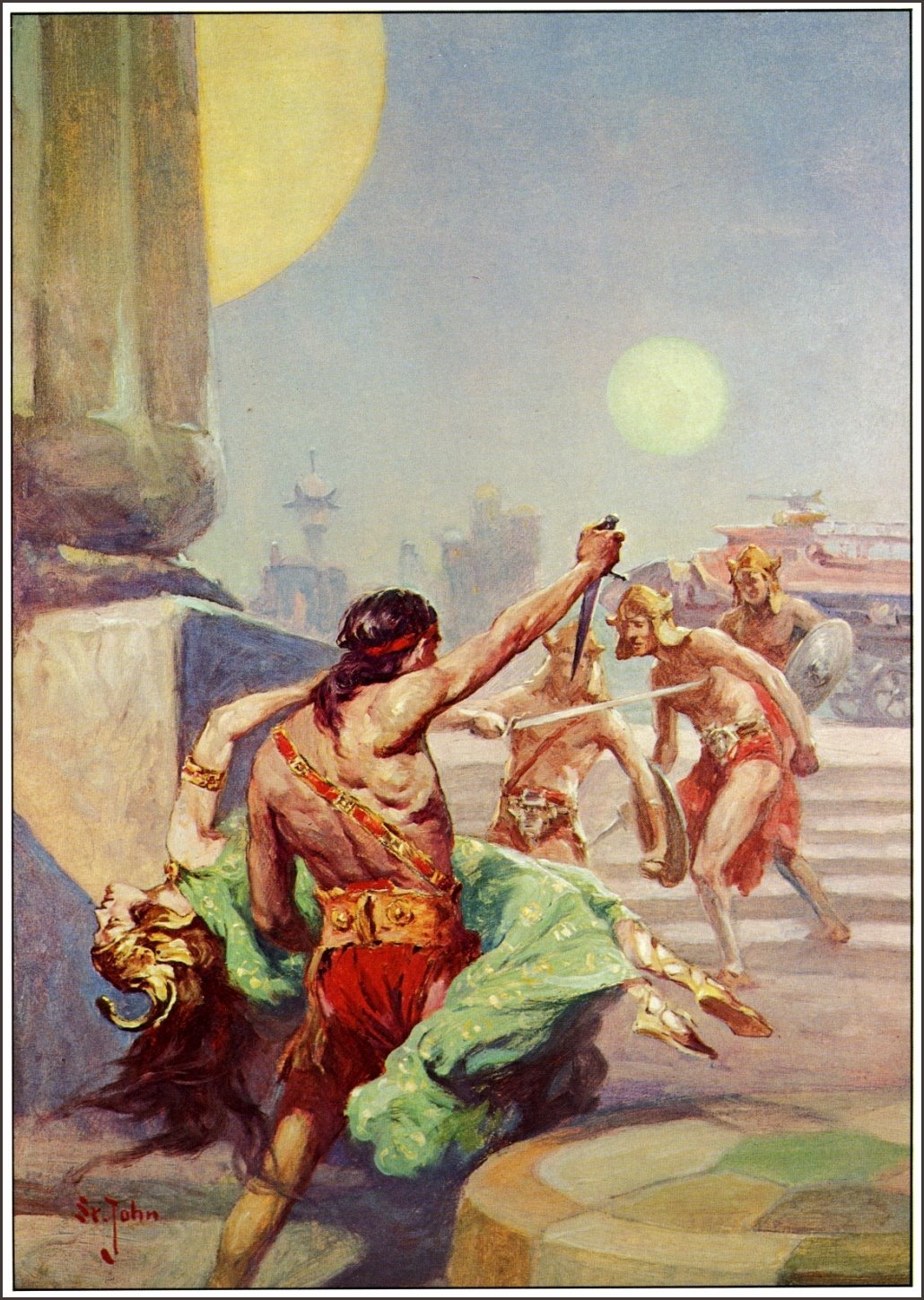
I saw this in a different way when I was going back through Edgar Rice Burroughs' John Carter of Mars novels. I'm cool with John Carter being a Virginian and veteran of the Civil War. I'm also cool with him becoming an uber-powerful warlord on Mars with children who are likewise members of elite Martian society. BUT when I started one of the later novels that hinges upon the villain insinuating himself into Carter's son's household as one of the slaves, I thought, "Slaves? The hero keeps slaves?" I got off the train. Back in the '70s I would have just shrugged and gone on. I've become less tolerant of some things and I've become more tolerant of other things.

These changes make me wonder which of the stories I've hated in High School or College that I might like were I to read them again today. I saw this with Hemingway, but I rather suspect I will hate Holden Caulfield even more today than back in 1972.

Most of my old friends are still friends, and I suspect just as many of my old irritants are just as irritating. The good thing is that nobody can make me do assigned reading like they did in High School.

Monday, August 5, 2013

Ten Years After

I've blogged about cancer before here. I'll try not to repeat myself and the careful reader should go back there and see whether I have repeated myself then yell at me about it.

Except for this:
When you have cancer you cannot control what they'll cut out of you. You cannot control what poisons they'll pump into you. Or when. Or how long. You cannot control the course of the disease, but you can control your attitude. I chose to appear to be optimistic despite knowing better. I had everyone fooled.
I said it again because I figure that's important enough for you to not miss. If anything I can write will save a life, this is it.

Here's something else to think about the disease: The victim isn't the victim. If you look back a decade, you'll see that my kids' grades went down. Nobody had a tearful meltdown. It was just a burden: dad is sick. Anybody who's suffering from cancer or any slow coast down the exit ramp has people around who are going to be hurting.

If you feel inclined to pray for the sick, pray for those close to the sick. Cancer isn't contagious, but sadness and grief are a burden to those closest to it. Don't overlook them.

When I went in for cancer surgery, I let everyone know. I encouraged prayer on my behalf. I was quite ecumenical in that regard. I have always been actively involved in various online communities and two local writers groups. As a result I have several non-Baptist friends: My name was mentioned in the local Synagogue. An Atheist thought positive thoughts. A New Age Pagan threw a stick in the ocean on my behalf. My surgeon said a Hail Mary for me. And others in other non-Christian and Christian traditions offered intercessory expressions on my behalf.

We might argue about the nature of deity being addressed.
We might doubt the existence of anything beyond the empirical.

I cannot doubt that all those folks cared.

The Baptist in me admits that maybe God didn't hear prayers addressed to someone else, but He overheard them. And He answered. When I was coming out of surgery it felt as if anything I asked for God would deliver. Because he was very direct and immediate about answering everything I prayed for. I joke that I should have asked for a winning Lotto ticket.

The thought occurred, along with an unbidden, "Don't abuse this."

There's a scene in the movie Shadowlands where the snarky Atheist taunts C. S. Lewis about prayer: You won't tell an omniscient being something he doesn't already know. You won't change the mind of an immutable (unchanging) being. And Lewis replied, "That's not the point. Prayer changes me."

Chemotherapy has an effect on your nervous system. On the second round of themo the poison gave me a peculiar reaction to the cold. One time when I got out of the car, some freezing rain hit the side of my face and it was instantly numb. Another time I didn't think and put my hand under running cold water, it felt like an electrical shock. I found this fascinating. I figured eating ice cream would be a Very Bad Idea.

Chemo also caused neuropathy in my extremities and that has taken years to heal. So long that I no longer find it amusing.

Chemo had an effect on my taste buds. Things didn't taste the same. I love spicy-hot food, but under chemo it was intolerably painful. I couldn't even use black pepper. This was a direct assault on my identity.

If you ever undergo chemotherapy, avoid all your favorite foods. You don't want unpleasant associations. I quit eating steak. I started eating a lot of black cherries and drinking a lot of sour cherry juice. Everything tasted like shit. You don't want to finish chemo and afterwards remember the awful way your favorite foods tasted like when your taste buds were poisoned.

Ten years ago today I had my last chemotherapy treatment. I made it and I'm grateful. If you're doing chemo, I hope you found this useful.

Saturday, June 22, 2013

I Go To Learn

Writers' Groups have certain protocols that the fledgling writer may not know. Years back I finished my first novel and went trundling off to a local writers group that met at the Urban Institute for Contemporary Art. (I always thought the third word of UICA should be "contemptible" since I was generally unimpressed with the various objects d'art being produced there. I hope it has gotten better in the interim.) The UICA had the good sense to kick out the writers a couple years back.

Nevertheless, I've learned a great deal from attending that and other writers groups and I'd like to share some of that here.

A local writers group needs a table and chairs and a public venue. If you're looking for one near you, ask around bookstores and public libraries. You'll most probably find a circle of like-minded people.

Each of them has swallowed minnows in order to listen to you read with baited breath.

Or not.

Most likely not. Too many people have only one thing in mind at a writers group: "I have to pretend I'm interested until it's my turn to read." That's wrong.

  • You go to a writers group to learn. 
  • You don't want to have your ego stroked. 
  • You don't want to establish yourself as the alpha writer. 
  • You don't want to discourage a bad writer from inflicting his turgid prose upon the world. 
  • You go to learn.

Suppose you write Science Fiction techno-thrillers. You should listen to the romances and the poetry of others to gauge what works and what does not. Not so you can start writing in another genre or mode, but to learn what makes words work. Even if all you learn is, "I should not do that."

And when it is your turn to read, you want to maximize your learning opportunity. Did you bring 20 pages? That's too much. People have limited attention spans. After 3 to 5 pages, minds wander. You want people listening to your deathless prose not plotting to kill you.

Are you really, really good at Oral Interpretation? Tone it down. When your book is in some publisher's slush pile you won't be there to pronounce all the syl-AB-les with the right em-PHA-sis. Your dramatic pauses and artful intonations won't help you. And even if you are lousy at Oral Interpretation, don't do it.

I knew a writer who was horrid, and when he read he felt this need to do so in a Swedish accent. I have no idea what he was writing about, all I know is I'd think, "Bork, bork, bork," and remember Muppet Show skits. Happily, he doesn't come to writers group any more.

Don't be that guy. The guy who everyone silently sighs in relief when he doesn't show up.

He read in a cheesy Swedish accent even after people told him it detracted from evaluating his work. He didn't listen. You have to listen. And you have to act on what you hear. Even if that action is independently verifying the truth/falseness of it. If you don't listen, you can't learn.

And if you don't want to learn you have no business being in a writers group.


Thursday, June 6, 2013

We're All Nihilists Now

In the '60s, a politician, or an economist opined, "We're all Keynesians now," to announce the death of common sense in the domain of economics. (And a fun game of a few years later was to troll people with claims that "Obama is a Keynesian" in hopes that someone would confuse Keynesian and Kenyan.)

After watching the 4th season of Arrested Development, I'm willing to hazard that we're all Nihilists now.

In the first three seasons of the show, you got the impression that there were these two relatively nice people I could identify with who had been embedded in a nest of vipers. Fun vipers, but vipers none the less. Michael was the protagonist and I always longed for him to bid adieu to the rest of the family and take George Michael with him. They were characters I could identify with because their moral compasses were not as thoroughly demagnetized as the rest. Sure, the other characters were a lot of fun, but they were evil.

Not the evil of Hannibal Lector, but the evil of Jeeter Lester that is feckless, ineffectual and funny.

The first impression I got from the 4th season was that Michael and George Michael wanted to get in on the fun. And this was reflected in the exorcism of the last shreds of integrity from their characters.

Even the cat-like Maeby who had been amoral and cunning (a perfect fit for Hollywood, right?) was transformed into just another wastrel. Her relative success was a breath of fresh air to the story.

The result is a show I enjoyed, but not one that I felt I could identify with.

I believe the problem was that it is truly nihilist now. The show depicts Gob as a "Christian magician" as a dual of his more successful rival a "Gay magician." Almost as if both homosexuality and Christianity are mere affinity groups with no more significance than being marketing niches. There was a time when a person's appetites gave him significance and meaning. And before that a person's religion. This is un-watered nihilism.

And not the assertive nihilism of the Germans in the Big Lebowski, but a much more flaccid sneer at everything.

Don't get the idea I think Arrested Development wasn't funny. Or that I didn't like it. I have not laughed harder than I did at a couple points in the series. And I've troubled you with not one but two blog posts about it.

I'm just a little troubled.

When my kids were little, we got a copy of Bill Bennet's "Book of Virtues." Which was an anthology of little moralistic essays and stories ranked from easy to hard. The hardest of the essays was written by C. S. Lewis and it was entitled, "Men Without Chests." In it, Lewis suggests that a society needs men who can stand when others run, men who take up the hemlock like Socrates and drink it to make a point bigger than themselves, men who engage something transcendent.

Lewis reminds us of the notion of "proper affections" which is a simple matter of loving that which is good, and hating that which is evil. But what is the good that I may love it? Is it an arbitrary preference to be decided by tribal leaders or dictated to the sheeple by someone with the will to power?

I'm not offering any answers to these questions, but I will observe that if your answers to them are lame, then your ability to devise believable villains will be equally lame. As will your ability to stand against tyranny.

Saturday, April 27, 2013

It Works Like This

I touched upon this obliquely when I claimed one ought never put two Sherlocks in the same room wherein I deprecated the practice of baffling the reader with a bunch of inside-baseball expert blather. And I've touched upon this obliquely when I noted that Science Fiction has a distinct expression that favors invention and science over sociology and culture. I'm more a fan of the Jules Verne expression over the H. G. Wells expression.

The writer may know things other than writing. For instance, Erle Stanley Gardner was a practicing lawyer before Perry Mason argued his first murder case. Police procedural stories are often written by former cops or forensic pathologists. Military Science Fiction stories are often penned by former military people. In each of these cases, the writer can truly say to the reader, "I know something you don't."

This enables the writer to do two things: 1) He can lend details from his experience. Mr. Gardner was able to use his own courtroom experience to insert small details that lend verisimilitude to his narrative. 2) He can explain how something works. If you want to see world-class explaining, pick up a Neal Stephenson book. You won't need a forklift. You just think you will. I'm interested in the explaining thing today.

Experts love to be true to their craft, and this makes them think, "I cannot dumb this down." They say this to justify writing that proves opaque to the ordinary reader. If you refuse to dumb something down, you're the dummy.

I was in the middle of my Masters' degree studies in Mathematics at Michigan State University when a visiting scholar came by to give a colloquium. He gave a talk on a topic of mathematics that was very difficult for me, and I knew I did not understand it going in. So, I was a little scared at the beginning of the talk. I needn't have been. The guy made the topic seem a lot easier than it really was. He knew multiple motivating examples for the key ideas and he knew which ideas were the more important ones.

I realized that this was the smartest guy I'd run into at MSU. It takes genius to make some things look easy.

C. S. Lewis famously said that if you cannot explain something to the woman who does your washing, you really don't understand it.

Understanding is like cutting a path through the tangled undergrowth of your ignorance. When I first learn something, I blaze one trail through this jungle and it twists about a lot. But when I learn a thing better, I have more than one way to get to the same point. All knowledge is interconnected somehow and the more you know, the more interconnects you possess.

Also, when I barely understand a thing, I don't know what's important and what's insignificant. Pretty much everything has to be held onto for dear life lest it be needed later. It's a lot less work when you know what the essential issues are and can dispense with the rest.

Suppose you're writing an explanation for something--like how a radio antenna works. You have to decide which parts of the explanation are pertinent or not. And then you can devise analogies that motivate the key ideas. An antenna element is not exactly like a tuning fork. It uses vibrating electrons to induce electromagnetic radiation whereas a tuning fork uses vibrating tines to induce sound. However, the process is essentially the same even if the details vary.

Cool facts about the partial differential equations governing the behavior of the radio waves can be left out of some explanation, because they are not pertinent to the story. Sure, you'll need to know them if you ever build an antenna, but not when you write for a popular audience. The expert is an expert because s/he knows what can be safely left out.

The expert is also an expert because s/he knows the connections between this thing and other things. Your audience may not know anything about short wave radio, but they do know something about other things, like snakes. Those other things they know about should be what you use to approach the subject.

I spoke of this obliquely before, but I'll say it directly here. The writer should make the reader feel empowered and good, not intimidated and bad. Maybe the reader lacks the time and the inclination to take a degree in radio engineering and/or pursue FCC licensing. But s/he can get a taste of the coolness of the work. The writer must be sensitive of and compassionate toward the reader to make the prose understandable and enjoyable.


Those more worthy than I: