I'm in my pop-up camper. Its only flaw is a lack of air conditioning. And the fact that I failed to set up the canopy outside the front door before it started raining. (The picture is from Labor Day last year or the year before that.) But I've got electrical power and wifi, so all is well with the world.
I have backpacker friends who will sneer and say this isn't camping.
Packing this time was enlightening, as in lightening, as in lighter. Years back I got my first laptop. It was a beast. A laptop has gone with me on every trip, big or small, ever since.
This has generally entailed a backpack wherein I'd keep the laptop, and its power supply, and various books I'd haul along. Packing was generally a Big Deal because I'd go through my bookcase and agonize over which books to bring along. I'd invariably bring along books I never opened and pined away that the books I was in a mood to read were sitting at home. Or I'd bring them all and that backpack would weigh a ton. Same goes for the CDs I'd pack along to listen to while driving.
Then I got a Kindle and packing changed to "what electronic gizmos will I take along." And that raised its own logistical issues because gizmos invariably need to be recharged. And that meant I had to pack along several cables and chargers in that backpack.
This year I packed a simple black nylon folio, roughly 8.5x11x2.5 in size with a shoulder strap. It has my MacBook Air, Kindle DX, and iPad. My smartphone, camera and iPod are in the side pocket. All the cables and wall warts went into a drawstring bag in my overnight bag. (I feel like a Luddite packing the camera when my smartphone has a perfectly serviceable camera.
I think that packing this much kit in such a small, light space is the best part of living in the future. The sheer complexity of such miniaturized gimmickry boggles this Engineer's mind. I'm grateful to live in such a time and wonder what marvels the future holds.
This has comments on my writing and reading. Primarily about Mycroft Holmes and stories involving him. Secondarily about whatever I'm reading at the moment.
Showing posts with label ipad. Show all posts
Wednesday, July 3, 2013
I'm Camping
Wednesday, April 10, 2013
Why SciFi?
My wife doesn't read Science Fiction. So, she asked me why I do. And why I write it.
If anyone gives you one answer and says it is the only reason, they're wrong. So, this is a non-exhaustive treatment.
The reasons for reading or writing Science Fiction include all the ones for other fiction: It's a pleasant way to pass a gray, rainy day. It provides distraction and amusement while going through unhappy circumstances. Reading is cheap entertainment. If you have straightened means, you can freely check out books from a library, or just let me know and I'll give you a copy of what I've published.
Science Fiction can be very mainstream or very genre. The lines get blurred. Action thrillers can easily include a SF gizmo with which the super-villain holds the moon for ransom. Romances may develop between dashing Civil War cavalrymen and time-travelling maidens.
I've explored elsewhere the relationship between Science Fiction and Fantasy as well as two broad themes of Science Fiction. And all that applies to this discussion of why one reads and writes SF.
Science Fiction prophesies about the Future
Ours is a technological society and the fruits of science and technology surround us. Science Fiction can cushion us against future shock. If I were to describe a typical workday to my teen-aged self of the 1970s, he would say it sounds like science fiction--because it does. I have an iPod, an iPad, an Android phone and a MacBook Air. Maybe I'll get an iPhone for my birthday. These devices are marvels of technology and I love living in the 21st Century.
But SF is a false-prophet. We haven't been back to the moon since 1973. We don't have jet packs. We don't have flying cars. Nuclear fusion power is still 30 years away. (Meanwhile I've gotten a half-dozen robo-calls today from various skeezy outfits. What fool does business with these companies? How do they stay in business?)
Despite the unexpected course of development with less progress in aeronautical or nuclear engineering, and more progress in telecommunication and electronics, we get glimpses into what the future will be like and get to play what-if with ideas like cloned replacement body parts.
Science Fiction lets us play what-if -- with things
Science Fiction is fiction because it often describes inventions that don't exist. There are no artillery pieces that will hurl a projectile from the Earth to the Moon. But if there were, what would it be like to use one? Or suppose I had a device that would transport me from anyplace to anyplace instantly?
Everybody loves unwrapping a new toy on Christmas morning and then seeing what it will do. Geeks and Engineers may also take things apart to see how they work.
Frankly, that's what I like about SF. I like inventing stuff that doesn't exist. I like coming up with a plausible-sounding explanation for why you want to fly into the sun and why the hyperspace drive works better there.
Doing real science is hard and so is making things work. But it's a lot easier when it just has to sound plausible. This may explain why Science Fiction doesn't predict the future perfectly. Flying cars are plausible, but iPods weren't plausible even when Steve Jobs announced them.
Science Fiction lets us grind axes
Star Trek was infamous for doing this. They ran into some alien whose skin coloration was ebony and ivory. And this alien was possessed of a murderous hatred toward the other alien whose skin coloration was ivory and ebony. Oh, i wonder if there was a message about racism in this episode?
Strangely, they never beamed down to the Planet of the Over-promising Santa Clauses, or Planet We-just-ran-out-of-other-people's-money. Do you think we should go on the Gold Standard? You can have enterprising spacemen from there show up to End The Fed.
But Wait! There's More
The reasons for reading and writing Science Fiction encompass more than what I've said so far. Ferinstance, I didn't say anything about giving you a good scare. So, tell me, why do you read or write Science Fiction?
If anyone gives you one answer and says it is the only reason, they're wrong. So, this is a non-exhaustive treatment.
The reasons for reading or writing Science Fiction include all the ones for other fiction: It's a pleasant way to pass a gray, rainy day. It provides distraction and amusement while going through unhappy circumstances. Reading is cheap entertainment. If you have straightened means, you can freely check out books from a library, or just let me know and I'll give you a copy of what I've published.
Science Fiction can be very mainstream or very genre. The lines get blurred. Action thrillers can easily include a SF gizmo with which the super-villain holds the moon for ransom. Romances may develop between dashing Civil War cavalrymen and time-travelling maidens.
I've explored elsewhere the relationship between Science Fiction and Fantasy as well as two broad themes of Science Fiction. And all that applies to this discussion of why one reads and writes SF.
Science Fiction prophesies about the Future
Ours is a technological society and the fruits of science and technology surround us. Science Fiction can cushion us against future shock. If I were to describe a typical workday to my teen-aged self of the 1970s, he would say it sounds like science fiction--because it does. I have an iPod, an iPad, an Android phone and a MacBook Air. Maybe I'll get an iPhone for my birthday. These devices are marvels of technology and I love living in the 21st Century.
But SF is a false-prophet. We haven't been back to the moon since 1973. We don't have jet packs. We don't have flying cars. Nuclear fusion power is still 30 years away. (Meanwhile I've gotten a half-dozen robo-calls today from various skeezy outfits. What fool does business with these companies? How do they stay in business?)
Despite the unexpected course of development with less progress in aeronautical or nuclear engineering, and more progress in telecommunication and electronics, we get glimpses into what the future will be like and get to play what-if with ideas like cloned replacement body parts.
Science Fiction lets us play what-if -- with things
Science Fiction is fiction because it often describes inventions that don't exist. There are no artillery pieces that will hurl a projectile from the Earth to the Moon. But if there were, what would it be like to use one? Or suppose I had a device that would transport me from anyplace to anyplace instantly?
Everybody loves unwrapping a new toy on Christmas morning and then seeing what it will do. Geeks and Engineers may also take things apart to see how they work.
Frankly, that's what I like about SF. I like inventing stuff that doesn't exist. I like coming up with a plausible-sounding explanation for why you want to fly into the sun and why the hyperspace drive works better there.
Doing real science is hard and so is making things work. But it's a lot easier when it just has to sound plausible. This may explain why Science Fiction doesn't predict the future perfectly. Flying cars are plausible, but iPods weren't plausible even when Steve Jobs announced them.
Science Fiction lets us play what-if -- with people
Are you scandalized when the old dude shows up with a trophy wife who's half his age? But what will happen when the dude is 900 years old and the trophy wife is 450? And a girl young enough to be his daughter would be 875 years old!
Or how about the starship pilot who's been in stasis for 80 years and he's thawed out by his great-grandson who has the same apparent age? How does that family dynamic work out?
Let's suppose you can clone replacement body parts. Sure, there are people who need heart transplants, but look at how much more money is spent each year for boob jobs? There's probably a lot more money to be made in upgrades of a cosmetic nature. And there's not as much liability if the replacement breasts fail.
Or let's suppose someone invents a device that tells when a politician is lying, and also when he won't keep a campaign promise. We might be surprised by politicians' creative responses to this challenge.
How would wars be fought if we only let robots do the fighting? Would we have more wars or fewer?
Science Fiction lets us grind axes
Strangely, they never beamed down to the Planet of the Over-promising Santa Clauses, or Planet We-just-ran-out-of-other-people's-money. Do you think we should go on the Gold Standard? You can have enterprising spacemen from there show up to End The Fed.
But Wait! There's More
The reasons for reading and writing Science Fiction encompass more than what I've said so far. Ferinstance, I didn't say anything about giving you a good scare. So, tell me, why do you read or write Science Fiction?
Labels:
Apple,
H. G. Wells,
ipad,
iPod,
Jules Verne,
MacBook,
Science Fiction,
Steve The Supervillain
Friday, February 22, 2013
Convert ePub to Mobi using Calibre
(This is the 6th part of my multi-part How To Publish An Ebook thang.)
If you have an e-reader or more than a couple ebooks, you should use Calibre to organize them. Calibre is like iTunes for ebooks. It is also free software.
Calibre enables you to download ebooks from your Kindle or Nook or iPad or whatever and then transfer them onto your computer's hard disk. When you have more than one ereader (or like me, one of each), Calibre is a good tool for putting an optimal mix of ebooks on each.
I don't approve of archiving all my ebooks on Amazon's or some other company's server. Instead, I believe I should have all the ebooks that I've purchased on my own hard disks and on backup medium. It stops Amazon from doing skeezy things like taking books away from you when they feel they must.
But that's not why I'm writing.
When you bring an ebook into Calibre it can convert it between different ebook formats. There are only two ebook formats you need to care about: MOBI and ePub (Sure there is LRF for Sony readers, and CLT for Microsoft readers, and PDF, and something else that's Apple-specific, but you really don't need more than those two ebook formats.) When you sell for the iPad, Kobo, Sony, or Nook, you provide ePub format files. And when you sell for the Kindle you provide MOBI format files.
The workflow that I follow, and that I recommend goes like this:
DOCX => HTML => ePub => MOBI
You use Microsoft Word to create DOCX files, then Rick Boatright's web page to convert to HTML, then use Sigil to build ePub (and make everything perfect), then use Calibre to convert to MOBI.
If, like Finding Time, your ebook has a lot of images/illustrations in it, you may need to compress the MOBI file to reduce the "delivery charges" that Amazon levies against large-sized ebooks. To compress a MOBI, just take the MOBI file and convert it a 2nd time to MOBI to make the compression happen.
Converting between ePub and MOBI formats is pitifully easy. Just go into Calibre.
This isn't rocket surgery, the guys at Calibre have done all the work for you, and the program is free!
One more word on workflow. I suggest you be prepared to run this process multiple times. The logical place to fix typos is in DOCX files. And then you'll have to redo everything downstream from there. The more you can automate of that downstream processing, the less painful typos will be.
And typos are one of the key indicators of amateurism in self-published ebooks. Be prepared to test the dickens out of your ebooks. Many eyes make shallow bugs. You want the maximum number of eyes on your books before publication.
(You can find the bullet-point outline of How To Publish An Ebook here.)
If you have an e-reader or more than a couple ebooks, you should use Calibre to organize them. Calibre is like iTunes for ebooks. It is also free software.
Calibre enables you to download ebooks from your Kindle or Nook or iPad or whatever and then transfer them onto your computer's hard disk. When you have more than one ereader (or like me, one of each), Calibre is a good tool for putting an optimal mix of ebooks on each.
I don't approve of archiving all my ebooks on Amazon's or some other company's server. Instead, I believe I should have all the ebooks that I've purchased on my own hard disks and on backup medium. It stops Amazon from doing skeezy things like taking books away from you when they feel they must.
But that's not why I'm writing.
When you bring an ebook into Calibre it can convert it between different ebook formats. There are only two ebook formats you need to care about: MOBI and ePub (Sure there is LRF for Sony readers, and CLT for Microsoft readers, and PDF, and something else that's Apple-specific, but you really don't need more than those two ebook formats.) When you sell for the iPad, Kobo, Sony, or Nook, you provide ePub format files. And when you sell for the Kindle you provide MOBI format files.
The workflow that I follow, and that I recommend goes like this:
DOCX => HTML => ePub => MOBI
You use Microsoft Word to create DOCX files, then Rick Boatright's web page to convert to HTML, then use Sigil to build ePub (and make everything perfect), then use Calibre to convert to MOBI.
If, like Finding Time, your ebook has a lot of images/illustrations in it, you may need to compress the MOBI file to reduce the "delivery charges" that Amazon levies against large-sized ebooks. To compress a MOBI, just take the MOBI file and convert it a 2nd time to MOBI to make the compression happen.
Converting between ePub and MOBI formats is pitifully easy. Just go into Calibre.
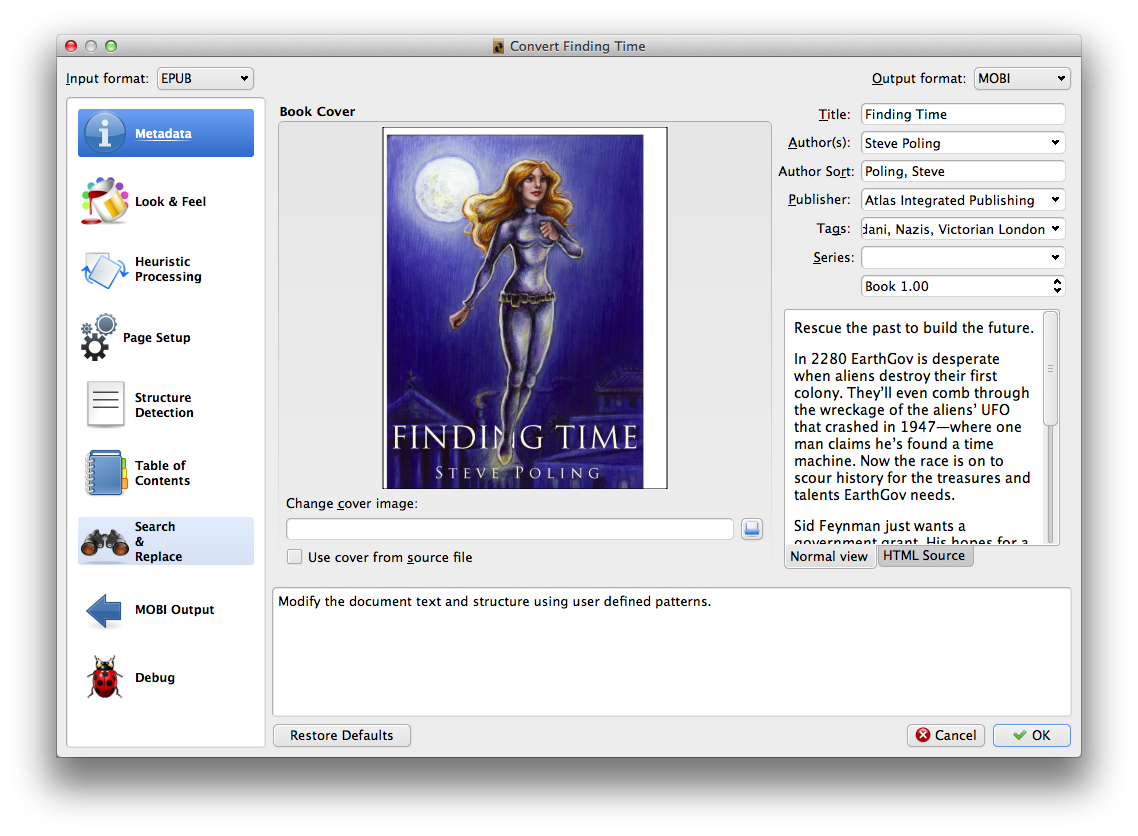
- Load your ePub file (from Sigil) into Calibre by clicking on the "Add Book(s)" button
- Right click on the book and select "Convert Books"/"Convert Individually" from the popuup
- On the upper left hand corner, verify that it says ePub
- On the upper right hand corner, verify that it says MOBI
- If not, change the buttons in the corner accordingly
- Verify the metadata on the file is as you want (it should have been set up in Sigil)
- Click the OK button
This isn't rocket surgery, the guys at Calibre have done all the work for you, and the program is free!
One more word on workflow. I suggest you be prepared to run this process multiple times. The logical place to fix typos is in DOCX files. And then you'll have to redo everything downstream from there. The more you can automate of that downstream processing, the less painful typos will be.
And typos are one of the key indicators of amateurism in self-published ebooks. Be prepared to test the dickens out of your ebooks. Many eyes make shallow bugs. You want the maximum number of eyes on your books before publication.
(You can find the bullet-point outline of How To Publish An Ebook here.)
Friday, August 3, 2012
What about Nooks and iPads?
Today marks the release of Finding Time on the Kindle.
The first question I got was, "What about the Nook or iPad?" My first answer was, "sorry, you have to wait." But my second answer is a lot better.
Amazon has a program they call "KDP Select." The way it works is you promise that you'll only sell your work on Amazon for a period of time, and they'll make it worth your while.
We'll see about that last part, but I signed up for it. And that means the earliest I can put Finding Time in Smashwords, or the Apple store is 90 days from now.
But you want Finding Time NOW. (I hope.)
The good news is that I never put copy-protection on anything I sell. Never. It's a matter of scruples with me. This means the file that Kindle will sell you can be translated between MOBI (Kindle format) and ePUB (Sony, Nook & iPad format), if you have a translator.
Happily, this file conversion is just two clicks in a program called Calibre that you can get for free at http://calibre-ebook.com/. It's a great program to get even if you don't get Finding Time or want to convert any ebooks!
Now, if you don't have a Kindle, you can still buy Finding Time. Below the "Buy it now" button is a drop-down labelled "Deliver to:". Select "Transfer via Computer". Then make your purchase and do what Amazon tells you to get the file. Remember where you put it.
After you download and install Calibre, connect your Nook or iPad or Sony. Wait a bit and Calibre will recognize your device.
Then import Finding Time into Calibre. It will ask you where to find the file. That's why I asked you to remember where you put it. Great, you're almost done.
Right-click on Finding Time from the list in Calibre, and select Convert Books and Convert Individually. A dialog box will appear and in its upper left hand corner, make sure it says MOBI and in the upper right hand corner, make sure it says "EPUB". Then say OK. This will start the file conversion process. Wait a few minutes for it to finish.
Make sure you've still got your Nook or iPad connected. You'll be able to select Finding Time and "Send To Device".
That's it. So simple, a fifth-grader can do it.
Update: I feel rather stupid, because I happen to have the Kindle application running on my iPad right now. So, all those iPad references should be Sony Reader, Kobo or some other platform that lacks a Kindle app running on it. Did I say I feel rather stupid?
The first question I got was, "What about the Nook or iPad?" My first answer was, "sorry, you have to wait." But my second answer is a lot better.
Amazon has a program they call "KDP Select." The way it works is you promise that you'll only sell your work on Amazon for a period of time, and they'll make it worth your while.
We'll see about that last part, but I signed up for it. And that means the earliest I can put Finding Time in Smashwords, or the Apple store is 90 days from now.
But you want Finding Time NOW. (I hope.)
The good news is that I never put copy-protection on anything I sell. Never. It's a matter of scruples with me. This means the file that Kindle will sell you can be translated between MOBI (Kindle format) and ePUB (Sony, Nook & iPad format), if you have a translator.
Happily, this file conversion is just two clicks in a program called Calibre that you can get for free at http://calibre-ebook.com/. It's a great program to get even if you don't get Finding Time or want to convert any ebooks!
Now, if you don't have a Kindle, you can still buy Finding Time. Below the "Buy it now" button is a drop-down labelled "Deliver to:". Select "Transfer via Computer". Then make your purchase and do what Amazon tells you to get the file. Remember where you put it.
After you download and install Calibre, connect your Nook or iPad or Sony. Wait a bit and Calibre will recognize your device.
Then import Finding Time into Calibre. It will ask you where to find the file. That's why I asked you to remember where you put it. Great, you're almost done.
Right-click on Finding Time from the list in Calibre, and select Convert Books and Convert Individually. A dialog box will appear and in its upper left hand corner, make sure it says MOBI and in the upper right hand corner, make sure it says "EPUB". Then say OK. This will start the file conversion process. Wait a few minutes for it to finish.
Make sure you've still got your Nook or iPad connected. You'll be able to select Finding Time and "Send To Device".
That's it. So simple, a fifth-grader can do it.
Quick, find me a fifth-grader.
Update: I feel rather stupid, because I happen to have the Kindle application running on my iPad right now. So, all those iPad references should be Sony Reader, Kobo or some other platform that lacks a Kindle app running on it. Did I say I feel rather stupid?
Tuesday, October 4, 2011
Public Service Announcement
I apologize for writing something only tangentially related to writing, but it has to do with eBooks, Kindles, and stuff.
Ebooks will change the way books are read and published. This threatens some of the not-poor who will have to change the way they do business. Just ask Borders books. It also will disrupt patterns of power distribution between writers, agents, and publishers. None of this should be news.
Do-gooders often like to write hand-wringing essays about The Poor. I recently read here and here that the widespread adoption of ebooks will freeze out poor children from reading. And you probably know that Amazon as dropped its prices to $79 for the normal Kindle, and $199 for the Fire. Now add one more component to this equation: public schools.
When I was a kid the nicest and most expensive books I ever saw were my textbooks. They were glossy, and colorful. Now, I just read here that public school systems are poised to save a lot of money in storage space and shipping costs by switching their texts to ebooks.
Can these savings subsize Kindles for public school children? One of Newt Gingrich's more outrageous ideas was to give laptops to homeless people. I still think it's ridiculous. But it makes sense to give Kindles to disadvantaged school children with their ebook texts.
I can see some very well-heeled corporations spending millions demonizing this idea. But there are even more millions to be made by Amazon, Barnes & Noble, and/or Apple switching public school children from dead-tree texts to ebooks.
Update: I hear that the Indian government is moving forward on something along these lines.
Labels:
digital divide,
ebooks,
ipad,
kindle,
nook,
public schools,
textbooks
Tuesday, September 13, 2011
Publishing, Ebooks, and Saving Money
The world is changing. Used to be that a few large corporations held unassailable monopolies on what you could read. They decided what got published, and what didn't. Since they were in the business of making money, they reasonably made decisions to maximize profits. Thus some amazing prose from some obscure genius would get tossed out of the slush pile while some porn star's ghost-written memoir would be fast-tracked. I'm not ragging on porn stars, just pointing out that in the traditional model, the corporation had a limited number of opportunities and it chose what maximized profits.
Is this what you want?
If you don't yet own a Kindle or a Nook get one. If you've already got a tablet computer or smartphone it'll cost you nothing to download the Kindle application.
No, go do it now. I'll wait.
OK, now that you've got a Kindle you're going to want to put something on it. And if you don't have a bunch of free ebooks from Project Gutenberg, you're missing out on a huge value.
When you go out looking for free ebooks from Project Gutenberg, you may notice some other ebooks are for sale. Amazon sells lots of them and most of them are about $9.99 (or they were until Apple won the right of traditional publishers to charge more). If you keep looking, you'll see there are tons of books that are free. And others like my story, The Aristotelian, that are $0.99.
There are a LOT of ebooks for $2.99 and under. A whole lot of them. It boggles the mind how many. How come? Because of Kindle Direct Publishing a lot of writers are bypassing traditional publishers and selling directly through Amazon. All the jobs that traditional publishers did are being done by the authors themselves. Or not being done.
Traditional publishers have a name for this kind of thing, vanity press. And since it undermines their profits they've done their best to discourage it. Oh, Mr. Bookseller, you don't want to carry that title, it's self-published. Same for newspaper reviews. Like it has cooties.
And there's a grain of truth in that narrative. A traditional publisher pays for editing, an editor is supposed to go through the text and do proof-reading to flush out any typos. Self-published work can sometimes skip this step, and statistically, you're more likely to find typos. Moreover, an aspiring writer may be so in love with his story, s/he'll disbelieve any report that it's not wonderful. Writers are dreamers who tell lies for a living and before they'll tell you any lies, they tell themselves lies about themselves and the quality of their work. If any writer says otherwise, reread the last sentence. Hence, some self-published works are unworthy.
You can find lots of cheap ebooks, but you won't necessarily want to read all of them. Whereas $0.99 much money, there's time. An ebook must be worth the time it takes to read it. Plus the time it takes to decide to buy it, plus the time it takes to find it.
What to do? The Traditional Publishers have a solution they'd like to push on you. Simply pay them $9.99+ and they'll decide which titles are worthy and which are unworthy, and they'll decide what you will like, too. And they'll tell you to do things their way or you'll drown in an ocean of self-published dreck.
There is another way. I go to flea markets, yard sales, and thrift stores to save money. I also sort through bins of CDs at Dollar Stores. Looking for bargains is like hunting. You take what you find with no guarantee up front what you'll find. You have to enjoy the hunt to sort through nicknacks at an Estate Sale. If you watch American Pickers, Cash & Cari, or Antiques Roadshow on television, you'll understand. I realized just recently that schlepping through a long list of cheap ebooks is just like this.
But there's a difference. When you're at an Estate Sale, and your search turns up some unrecognized treasure, you snap it up for yourself. If there's two, you grab it, too. And you brag to your friends at what a great find you acquired. All they can do is envy you. Conversely, with ebooks there's no limit per customer. You can download it, and your friends can, too. Or your friends can report to you what treasures they've uncovered!
Everybody wins, except traditional publishers who'd rather charge you $9.99+ and tell you what to think.
Subscribe to:
Posts (Atom)