Showing posts with label Evil. Show all posts

Saturday, October 5, 2013

Strange Love

A friend recently remarked that she really loved old-time songs she termed "hellfire and brimstone," but she felt the old-time songs didn't love her back.

She was right, but she was wrong.

The Westboro Baptist crowd is an exception I'll describe in hopes of making my point by contrast. I once watched one of their YouTube videos where the girl spent five minutes repeatedly saying, "You're going to Hell," in a perky voice with a smile on her face. One cannot say this with a smile on your face and have an infinitesimal of love in your heart.

I think there is a sort of sadistic personality type who enjoys inflicting emotional pain on others. Such people are beneath contempt.

Such people are NOT the folks who were writing and performing the old-time "hellfire and brimstone" songs.

What were they thinking?

My earliest memories of church involve crying. "Hellfire and brimstone" sermons are not as common as they once were, but if you read any of the old-timers' books about soul winning, they say there ought not be a dry eye in the place. The fellow who wrote the book on "Hellfire and brimstone" just happened to be a Christian philosopher named Jonathan Edwards. He reasoned that a sinner doesn't love God, but he may love his own skin enough to seek a way of escape and thereby acquaint himself with the good news parts of the Gospel. Upon learning what God has done for the sinner, the sinner may think it fitting to love God back.

If you really believe those around you are at risk of destruction, the compassionate thing to do is warn them and share what you know about how to escape.

This line of reasoning makes the "hellfire and brimstone" warnings an expression of love. So, my friend is indeed loved back. But it's a strange love. The only way you can distinguish this love from Westboro's hate is whether the person saying it is crying or smiling when s/he says it.

Now, when writing a plausible villain. The conventional motives are money, jealousy, hatred and revenge--Plus whatever other negative emotions I've overlooked. Better motives are unconventional, positive emotions.

Provided you can make them plausible.

You see, it's because I love that young girl that I inflicted all those tortures upon her and eventually burned her at the stake, because God would judge her witchcraft more harshly and perhaps my efforts turned her to repentance and the joys of Heaven. 

Right.

Religious fanaticism is a dangerous thing when writing villainy department because a) it's overdone, and b) most writers doing it are functionally illiterate of religion. Their villains come off as off-key and get all the trust-cues wrong. And I hate when they do that.

So, I suggest something different.

My favorite villain is the Operative in Serenity. He's perfect because he's not motivated by the stale and trite things. He says he's motivated by Faith. Not the concrete Faith in God that J. Gresham Machen wrote about, or the vague objectless Faith in Faith that Soren Kierkegaard wrote about. His faith in the government who empowers him and sends him on his killing spree.

In a post-Christian, or post-Theist society, there are some folks who will still need to find something bigger than themselves to put meaning and purpose in their life. If they are Atheist, then the government is the second-best thing. Thus, I see a government fanatic is a better villain than a religious fanatic.

Mindful of this, consider this quote by C. S. Lewis:
“Of all tyrannies, a tyranny sincerely exercised for the good of its victims may be the most oppressive. It would be better to live under robber barons than under omnipotent moral busybodies. The robber baron’s cruelty may sometimes sleep, his cupidity may at some point be satiated; but those who torment us for our own good will torment us without end for they do so with the approval of their own conscience.”
So, next time you're wondering about your next villain, perhaps you'll consider some sort of overbearing altruist.

Thursday, July 18, 2013

Depiction is not Endorsement

I was discussing a movie with a friend, A Clockwork Orange by Stanley Kubrick. And my friend casually said that there were a lot of misogynistic movies in the '60s. This bothered me, because it implied that Clockwork Orange was misogynistic. I don't think so and here's why.

The movie follows the exploits of a band of evil men, termed droogs, moving about a utopian socialist Britain. I think that is an important aspect of the movie's message. These young men aren't stealing loves of bread for starving loved ones, they have every material need supplied by a generous government. Yet they are evil.

To demonstrate how evil they are the movie shows them perpetrate serial rapes, assault, and murder. (I've said elsewhere that this movie could not be set in America with its Second Amendment. An armed citizen would put put down a rampaging droog like a mad dog.) In particular, the movie shows brutal rapes and assaults to remind the viewer that these aren't just boys out having fun, but murderous villains.

IF the movie showed women "asking for it" by dressing or acting provocatively, then excused the droogs on that basis, YEAH that would be misogynistic. Big Time. This movie does the opposite of excusing or justifying violence against others, it condemns it and uses it as a premise for what happens in the 2nd and 3rd reels.

Ergo, I don't think the depiction of violent assaults perpetrated against women makes the movie misogynistic. You may disapprove of the crimes Stanley Kubrick depicted. For the love of God I hope you disapprove!

Where it might be sexist, I suppose, is that women were victims to evoke greater sympathy in audiences. Is it sexist to think women are inherently weaker or less capable of defending themselves? Is it sexist to think viewers will be naturally sympathetic to a female rape victim. Maybe, but that's a bit of a stretch. (And the 2nd Amendment empowers women to carry an equalizer.)

EVIL is part of the human condition. The Problem of Evil won't be solved this side of Judgment Day, so evil is a worthy subject of depiction in art. Art tells the truth and there are truths about evil that art should depict and explore. In my own prose, I've depicted various acts of evil. I desperately hope none of them are ever regarded as endorsements for those crimes. Yet, because I want my art to tell the truth, I feel I should accurately depict criminal acts of which I do not approve.

As stated elsewhere, criminal acts are more common in the small than in the large. For every criminal mastermind there are a legion of petty crooks. Now, if you're the kind of writer who wants to Tell The Truth About The Human Condition, then you'll want to depict a mix of petty acts of crime and major cases. There is such a thing as horrendous atrocities--like shooting up a grade school--but those things are relatively rare. If you're going to tell the truth about the human condition, then you should depict both venal and mortal sins.

The hard thing about good and evil is knowing the difference. There are things that I think are evil, that if I told you, you'd think I'm evil for thinking them evil. Should those things come up, I'll depict them as accurately and as honestly as I can, while leaving the reader to make his/her own mind up about good and evil regarding these things. Other things like rape, murder, and assault are not in this category, the writer can express disapproval, but the wise writer doesn't hit the reader over the head with a moral club.

Or let's consider the n-word. Suppose you have a low-income white boy using the n-word a LOT. And let's suppose he even says of an industrial accident, "nobody was killed except a couple <<n-words>>." Now, if I tell you the white boy is the hero of the novel, you'd think the novel and the novelist racist. Right?

BUT suppose I tell you a little more about this white boy who uses the n-word: He's a fugitive and he's helping Jim, an escaped slave, get away down the Mississippi river. And the author is playing a sly game of showing a noble black man surrounded by white savages. Huckleberry Finn is in the middle coming to realize Jim is a better man than the whites known as "the duke" and "the king" who are scalawags.

By depicting Huck Finn's moral journey from unthinking racist to enlightenment, the novel is the opposite of racist. It is anti-racist. Depicting the evil of racism in this novel is Mark Twain's sly method of condemning racism.

When you find your story taking you into something you don't approve of, you should tell the truth of it. If it's something we all agree about like Nazis, we'll understand the irony of Springtime for Hitler. If it's something like rape and murder, it should be clear you're not endorsing it. But a reader like my friend can err by thinking it's misogynist or racist.

That's a risk, but I think the game is definitely worth the candle.

Tuesday, July 2, 2013

Sorry

Sorry.

If you celebrated Canada Day, you may say soooorry with a long-o-with umlaut sound.

And if you hail from the UK, you say it when you approach a shop clerk with a purchase. In the US, it is generally reserved for a greater degree of contrition.

I was watching a Bollywood movie over the weekend and was again struck by a contrast with Hollywood. The movie, Jodi Breakers, begins with the hero celebrating his divorce from his practice wife, Satan. It proceeds with comedic effect to show him and his partner expediting divorces. Things go well until they break up the wrong marriage.

They approach the family matriarch, confess the misdeed and she gives the protagonist a tight slap. They do that in Bollywood when someone perpetrates a dire injury upon another. And then he said, "I'm sorry." The matriarch isn't about to shrug it off and accept his apology, she expects him to work it off. I first saw this pattern in Bachna Ae Haseeno, where the guy leaves girls standing at the altar and later seeks forgiveness from them.

India is not a society steeped in Christianity, so there's no cultural memory of the parable of the two debtors. Which is a good thing for the storyteller. (Christians forgive so easily that they make non-Christians think we don't take guilt seriously. By making the protagonist suffer to make things right, the Savior's sacrifice gets a fresh significance.)

Mostly, it improves the story as one character makes another character jump through hoops to win forgiveness. Why is this character doing such-and-such? Because the other character demands it as a condition of forgiveness. This might be something you can use.

If you are going to use guilt and forgiveness in your story, you should have a well-magnetized moral compass. You have to know right and wrong. You have to know the difference between venal and moral sins. And you have to realize that different people respond to the same crime differently. In the British movie In A Day, the crime is childhood bullying. The price of forgiveness is higher when the wounds are more painful.

A well-magnetized moral compass or a solid grasp of psychology.


Friday, January 11, 2013

Sickness and Evil

I recently saw a TED talk about psychopaths and I came to think that a lot of normal people are wrongly identified as psychopaths. At the end of the talk the speaker says he refused the offer of lunch with a fellow who'd been released from an insane asylum after many years of perhaps wrongful incarceration. He posed it in "what would do?" kind of way.

The presumption in my mind when I heard the talk being that we should not shun a person with a mental illness. It's not contagious. But then I got to thinking, there are other reasons to decline a lunch invitation with someone.

I would not decline lunch with Elmore Leonard because I think he is a wonderful writer. I believe he has a real understanding of criminal motivation and it comes out in his writing. I've complained elsewhere about the bogus motivations of some villains. But truer words have seldom been spoken than,"In Elmore’s world, death stalks the land disguised as money.” I love the lines of dialog Mr. Leonard puts into his characters' mouths.

Elmore Leonard writes about criminals who have a crystal clear motivation: money. Criminals motivated by getting money are fun characters to read and write about because most of them are stupid enough to get caught, but they think they're smarter than they really are.

"No, dear, you just THINK you're Professor Moriarty."

I don't think we can ever write about a villain motivated by insanity. Let's suppose the fella thinks he's an emperor simply because some moistened bint lobbed a simitar at him. No crime in that. But let's suppose he proceeds to behead his girlfriend for treason when she deprecates watery tarts as a basis of government. His crime is motivated by preserving power, not by insanity. Insanity is a means, not a motive. Likewise, when a woman drowns a kitten because she thinks it's a demon, her motivation isn't insanity, it is purifying the world. This is a twist on the mistaken-identity, misunderstanding conflict between characters.

After money, Revenge is an effective motivator for both villains and heroes alike. When the Hebrew prophet said "an eye for an eye" he limited the damages that can be lawfully sought by an aggrieved parties to just an eye. He did this because it is common to amplify slights into major insults.

Revenge motivates the villain most villainously when it is disproportionate.

Suppose you lost you job as a school treasurer--an elected position. And suppose further that your home was in default and about to be foreclosed upon by the bank. And you hope to revenge yourself against the voters who insulted you by voting for the other guy and the bankers who want to take your house away. What to do? It's altogether reasonable for someone angered in this way to seek revenge and do so in the largest way possible.

This could be done, if you're evil enough, through a number of purchases of explosives over the course of months and the placement thereof in your home and the local public school--the site of your humiliation.

Nothing particularly crazy about seeking revenge is there?

In Bath, MI on May 16th of 1927, an evil man did did exactly that killing several dozens of innocent children and adults. The mind recoils at such evil. Rejecting it, we think he had to be sick. No, he was evil.

In the decades that have followed, other feckless losers have perpetrated similar crimes and the phrase, "If it bleeds, it leads," is part of the news cycle. So much so, that the Revenge motive is supplemented by the Notoriety motive.

This brings us to the legal, but evil acts of news outlets who profit from the pain of disasters like this. You can sell a lot of newspapers displaying the image of the feckless loser and endlessly asking "why?" Give us dirty laundry.

This is legal, but it is evil. Legal-but-evil acts are the Original Sin of the businessman. For this reason Hollywood can easily and believably paint the manufacturer, the employer, the producer as the villain.

Criminals motivated by getting money are stupid enough to get caught. The ones that are smart enough to NOT get caught find evil-but-legal means to enrich themselves by impoverishing the rest of us. They aren't criminals because they never get caught. We are all a little less safe whenever the media makes the feckless loser mass-murderer into a pop-star.

So let's return to the fellow who was incarcerated for several years as a supposed psychopath. When you consider the sane acts of this person, you realize the man is amoral. He regards other people as mere furnishings of his life. Maybe he's sane or maybe he's crazy, that's questionable. But there is no doubt the fellow is a little more evil--he has less regard for his fellow-man--than most others.

Thus, I would have no qualms about declining a lunch invitation, not because he's sick, but because he's evil.

Wednesday, December 19, 2012

Free Will And Madmen

This world sees violent, evil acts by murderous individuals.

When the evil is particularly heinous we seek to assign blame. Someones flew airplanes into buildings? Someone shoots up a school? Never let a crisis go to waste.

A headline crystallized my thinking: "What if nobody or nothing is to blame for ...?" (I take pains never to utter the name of anti-martyrs, lest the repetition of these nobody's names encourage like-minded losers.) When a crime is sufficiently horrendous, the mind recoils and we think, "surely, the perpetrator must be mad."

Maybe, or maybe not. I have no desire to understand evil as much I have a desire to eschew it, punish it, and prevent it where possible. Then kill it.

The notion which stuck in my craw is "blame." If we believe that men are mere automata set into motion by forces outside themselves, then those forces which bring about criminal acts are to blame. But if we think that men are free moral agents, and if we hold men responsible for their criminal acts, then "blame" rests on the shoulders of the perpetrator.

We can never say, "nothing or nobody is to blame," because we can ALWAYS say the perpetrator is to blame. Even when the perpetrator is a madman.

Saturday, May 26, 2012

Sherlock Who

The BBC series Sherlock airs on American PBS stations.

It just finished its second season here in the States and I thought it fitting to share my opinions. The show was created by Steven Moffat and Mark Gatiss. Those names seemed familiar and I did some googling. Yup, those guys were big in the reboot of Dr. Who a few years back.

This is good news because the Dr. Who reboot has been wildly successful. It's also bad news because the biggest mistake made in the reboot was carried forward into Sherlock.

Any story whose protagonist is somehow special must soon acquire an arch-nemesis who is equal in every way to the hero, but evil.

In Dr. Who the arch-nemesis is another Time Lord named the Master. In the original Dr. Who series the Master was a fellow who looked sort of like a Spanish count. In Law & Order Criminal Intent the arch-nemesis was Nicole Wallace. She was delightfully evil and quite easy on the eyes. However, when they rebooted Dr. Who the Master was cast as a sort of nasty schoolboy. Cruel for no apparent reason, he acted immaturely and i found it impossible to take him seriously.

Speed forward to BBC/PBS Sherlock.

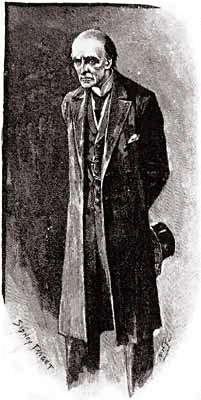
Writing when he did Arthur Conan Doyle did not know that he had to give Sherlock Holmes an arch-nemesis. When he wanted to kill off Holmes and go on to something else, he created Professor James Moriarty. In so doing Doyle created the pattern of the arch-nemesis.

People smarter than I have described the necessary prerequisites of an arch-nemesis. One necessary prerequisite of an arch-nemesis is that the reader (or viewer) take him seriously. I could not take seriously either the clown who played the Master or the other clown who played Professor Moriarty.

Evil, like truth, is complicated. You can't just take all the virtues and swap them out in equal measure with vices. Or you'll get some useless old sot shambling through scenes. For my money, the best villain I've seen in a while is The Operative. He's so evil, you don't even learn his name. In his case he believes in the Alliance and he believes the ends justify the means. HIS means generally consist of killing people with his katana.

He kills for his faith.

What made the Operative so effective was that he held all the virtues intact, but he was pursuing an agenda given to him by the Alliance. Years back I saw "The Day The Universe Changed." In the opening scene James Burke shows a witch burning and describes what could they be thinking to do such a thing. Clearly, the end of saving the girl's soul from eternal hellfire justified end means of burning her alive. Such thinking also motivates savages who fly airplanes into buildings.

But villainy is not one-size-fits all. One does not become a Nazi all in one go. Instead, small steps, baby steps are made one at a time weaving a cord of character that ends in evil and arch-evil. C.S. Lewis shows this in Perelandra and again in That Hideous Strength as reasonable, civilized individuals are transformed into demonic villains one seduced step after another.

I think that the reason why Dr. Who muffed the Master and Sherlock muffed Professor Moriarty stems from the fact that the grammar of virtue and vice, of good and evil, has been lost to this generation of Englishmen.

Friday, March 30, 2012

Anti-Turing tests

One of the least-expected things the Internet has taught me is to ignore Spambots. It's pretty easy to spot the offering for male enhancements or the like. The filtering software is getting better at pulling weeds, but still some gets through. Sadly, Spam has spread to every form of online messaging such as Twitter.

While weeding spambots from my Twitter account I noticed something disturbing: The amount of humanity in a Twitter update could be very low. Some humans can act like spambots and often do so. I don't want to their posts cluttering my Twitter feed any more than I want to see offers for male enhancement.

What I've been thinking through is a sort of Anti-Turing test to judge how human my interlocutor is. If you weren't trained as a Computer Scientist, the British Cryptologic-Mathematician, Alan Turing, proposed a test for machine intelligence. Instead of figuring out how to program IQ tests and administer them to machines, he suggested putting a person in the room with a teletype and the other end of the teletype would either be another person or a computer. He suggested that when the computer could be programmed to be indistinguishable from the person, that would constitute a human level of machine intelligence.

(It's interesting that intelligence is an aspect of a Turing test, but I'll come back to that.)

Consider this conversation:
"Hello"
"Buy my book"
"How are you doing today?"
"Buy my book"
"Did you know a meteor is about to destroy the planet and we'll all die?"
"Buy my book"

There's zero humanity in the responses, but suppose you added some social fluff. The minimum necessary to not seem rude. There'd be some humanity there, but not much. So consider the following conversation:
"Hello"
"Hello. Nice to hear from you. Did you know I've got a book out?"
"How are you doing today?"
"I'm feeling a chill--I should get a sweater and curl up with a good book."
"Did you know a meteor is about to destroy the planet and we'll all die?"
"No. That sounds horrible. Do you want to buy my book so you won't think about the meteor?"

That sounded pretty much like a human, but a cheesy one.

I used an exhortation to buy my book as a dehumanizing element in these example, but it applies equally well to other exhortations: Trusting Jesus, Electing Whigs, Ending Childhood Hunger, or Ending Childhood Obesity. Humanity is can be seen in concern for a larger cause, but the cause often demands human sacrifice.

This is why when you advertise that you're an activist, there's a risk I'll mistake you for a spambot, or worse a zombie whose soul has been sucked away by The Cause.

This goes for name-calling. If you dislike some public figure, you don't need human-level intelligence to call him a poopy-head. That's why Rush Limbaugh apologized for calling an activist a slut. Maybe this woman's demand for birth-control did not indicate fornication or otherwise betoken sexual promiscuously, but he had no knowledge of her sex-life. His rhetoric was mere name-calling and I disapprove.

I think a much more damning indictment of the woman would be to call her an activist.

As mentioned above the Turing test was devised as an intelligence test. Humanity is a broader concept than mere intelligence. Jeremy Brett played Sherlock Holmes as an inhumanly brilliant intelligence. The way he and other players have depicted Holmes' extreme intelligence was to act rudely and insensitively. (Anyone in grade school should know that this isn't smart.) In movies, this rudeness is a mere device to convey to the audience that here's a smart guy. It is like talking very fast and using big words like the Architect in the second Matrix movie. (Did he say anything? No, but he sounded smart.)

In real life, this rudeness is often low social skills. I trained as a mathematician and I was in class with a lot of smart guys with low social skills. I make wider allowances in such cases.

This brings us to people with undeniable humanity who are nonetheless unpleasant? Intelligence makes a person see things more quickly and grow impatient with someone who more slowly comes to that point--or grow enraged by someone who seems obtuse about missing the point. Combine this with low social skills, and someone can come off as a jerk.

I don't want to be a jerk, but I don't want to listen to jerks. I don't watch House because I can't believe anyone would be stupid enough to voluntarily associate with him. When Jean-Paul Sartre said "Hell is other people" he must have been a jerk and was forced to work with jerks.

Humanity has other negative aspects in addition to being a jerk, the Internet has taught me the concept of a troll. The troll wants nothing more than to see people lose their cool. This is evil and I won't voluntarily associate with evil.

In sum, I have three principles of associating with Internet entities:
  • Manifest your humanity
  • Don't be unpleasant
  • Don't be evil.


Those more worthy than I: