Showing posts with label Edgar Rice Burroughs. Show all posts

Tuesday, March 4, 2014

I Used To Like X

I want you to fix in your mind your favorite artist. Make a list of all the things s/he did to make you like him/her. Let's suppose you like the way s/he puts words together. Or you like the way s/he provides insight into the human condition. Or you like that clever twist at the end of his/her short stories. Now, for the purposes of this essay we'll refer to this artist as X.

If I met you in a coffee shop and mentioned X, you'd wax rhapsodic about him/her and recite at least some of those things on that list that I asked you to make.

Now, suppose that you discover that wonderful creative person you had in mind was also a leader of the National Socialist Party. Or s/he was outed as a closeted KKK member.

I'm supposing that everyone reading this hates fascists and white supremacists. But if you don't, substitute something else that you hate. (It is an unfortunate trait of our society that we tend to identify mutually antagonistic classes of people and then we set at each others' throats.)

Armed with this additional factoid about X, let's return to the coffee shop and I ask you about X. Now what do you say? Perhaps you'll feel rather sheepish: regarding X's writing as a guilty pleasure, or perhaps denying any enjoyment of X's work.

Then imagine the next time you're in a bookstore and you see X's latest work on the shelf. Will you snap up a copy with the same fervor as before? And after you finish it, will you post a review that is as positive as before? Or maybe not, you don't want the taint of association with double-ungoodness.


If you are an artist, you won't want that taint, and you won't want to be identified with any demon groups. This is a matter of personal brand management. Though it is easy to eschew evil in its Nazi and White-Supremacist forms, it get tricky when you're a Republican looking at a Democrat artist, or vice versa. (That's why I'm a Whig. A pox on both your houses!)

A bit of controversy can be great fun as any fan of cismale gendernormative fascism or glittery hoohas can attest. If someone on one side says something ridiculous and someone on the other side responds with ridicule, pass me the popcorn. This explains why I like Larry Correia and Sarah Hoyt.

It's easy to go too far as I've said about Ann Coulter. I'm not concern-trolling Mr. Correia or Mrs. Hoyt, because they have NOT gone too far. But I am not interested in tilting at every windmill. Unless you really enjoy slapping around idiots, there are some topics of conversation you might want to avoid. Some controversies are more interesting to me than they are to you, I want to shy away from those you'll find boring.

Let's return to your friend X. It is common in these busy times to go off half cocked. Internet mobs are like traditional mobs in that low-information people respond to half-truths or lies with great passion. Thus we may find that X really isn't really a Nazi, but s/he said something that could be construed as such. Or maybe X's art was wholly independent of his/her Nazism.

If you liked X because of his/her art, and you discover a taint of something evil in X, you should remember the line between good and evil runs through the heart of every person. You should be slow to judge until you've got all the facts. And checked them. And you should temper your judgment with understanding.

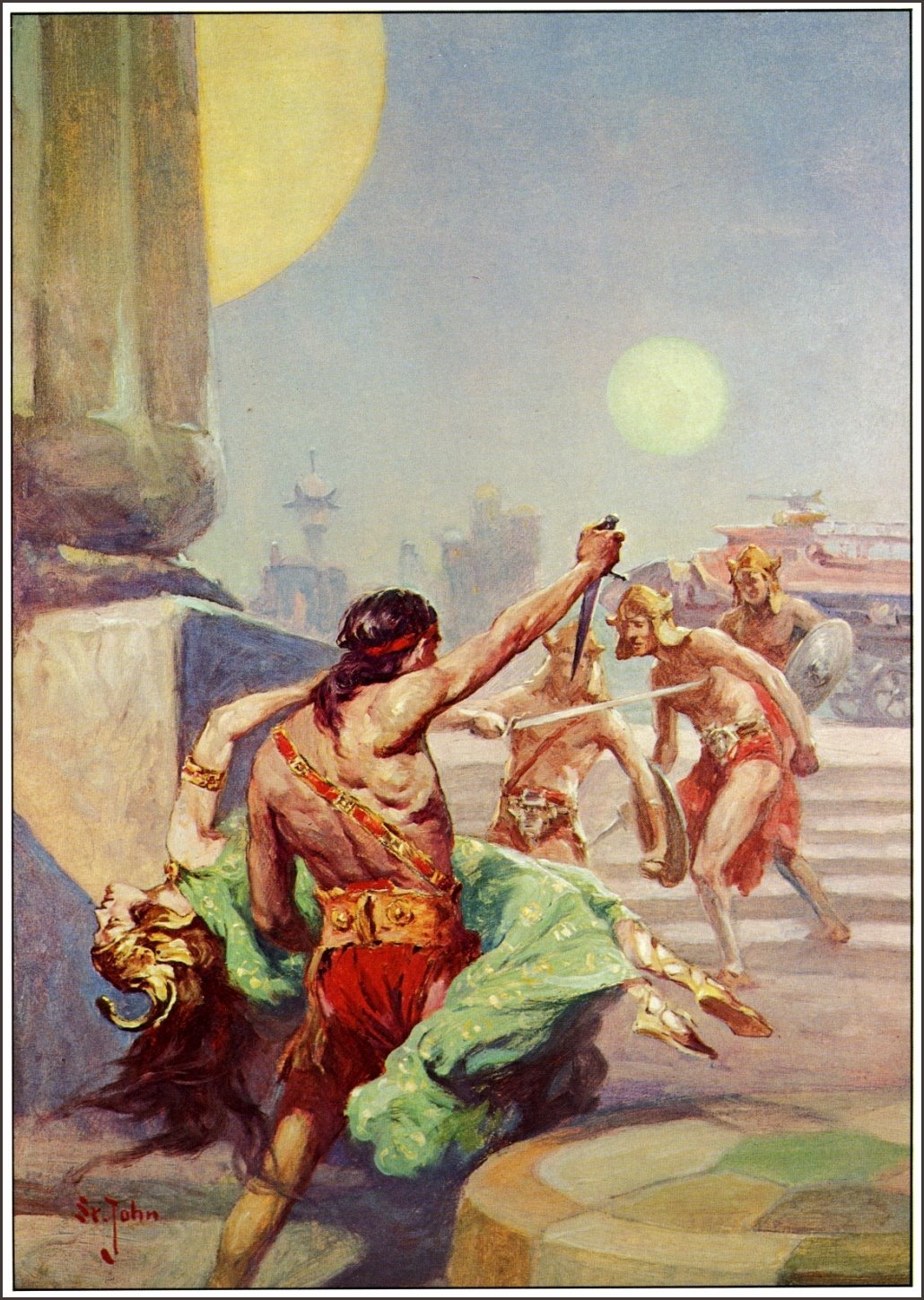
I fondly remember the Tarzan and John Carter novels by Edgar Rice Burroughs. My enjoyment thereof is alloyed somewhat by accusations of racism, but I cannot deny he could spin a great adventure yarn. Though I used to like Edgar Rice Burroughs, I should not dismiss his work.

Monday, August 12, 2013

Hello Old Friends

I was working on my deck Friday. The weekend was nearly here and I was wrestling with a software fault with my head down. I heard a clunk and looked up to see my wife, Mary, had dumped a box of books off the edge of the deck into the grass. I didn't appreciate the disrespect with which they had been treated but I understood why.

The box had sat next to the furnace in my basement and collected a little dust in the several years it resided there. Before that, it sat for many years next to the furnace in my father's basement. I should say furnaces, because while the box resided in Dad's basement, he had a coal-fired furnace, a natural gas furnace, and a wood-fired furnace. Between the coal and wood smoke the box was well sooted.

Dumping the box's contents into the lawn was the first step in removing the cobwebs, dust, and soot from my books. There was such an accumulation of dirt because the box has sat in one basement or another since the the 1970s.

After my wife finished dusting off books and asking me which ones she could discard, she got another box that was likewise filthy. And another.

I kept an eye out for an old friend, but didn't see him. I knew my dusty copy of The Green Hills of Earth had recently been in one of those boxes. Turns out my wife had already cleaned it off and shelved it. But another book, just as old, from Junior High was in the first box. It was a paperback anthology of space travel stories edited by Groff Conklin, Great Stories of Space Travel.

After I finished work I picked it up and started reading. I know that I had read all the stories a few times since I'd bought it in the '60s for half a buck. But enough time had passed that I'd forgotten all but general impressions of the stories--many of which were written in the 1940s. This was probably the book, or one of them, that got me into Science Fiction in the first place.

If you are a reader, you probably have the same emotional reaction when you return to a book after a long time. The stories and characters reside in a special place in my heart. Revisiting a story is like a reunion with its characters who are now old friends.

If enough time has elapsed, it gets interesting, because there are changes.

I noticed something when I picked up my copy of C. S. Lewis' non-fiction book Mere Christianity. I was reading an argument Lewis was making about the existence of God and it was completely unfamiliar. I knew the line of reasoning, because the night before I'd said something similar, but different, in an email to an agnostic friend. The unfamiliarity of Lewis' words made me think my 18-year-old self had paid insufficient attention at the time.

Then I saw it. My handwriting on a note in the margin. The note was on point and proof that I had indeed been paying attention. Yet, the words were unfamiliar. And I'd said the same thing in my own words decades later.

The changes were in me. I felt a bit like Bruce Willis in Looper talking in the diner with his 30-years-younger self.

In this case, I'd digested what Lewis was saying, incorporated it into the structure of my thinking, and reworked it over the years into a form that fit me so well that Lewis' original expression was unfamiliar to me.

I saw this in a different way when I was going back through Edgar Rice Burroughs' John Carter of Mars novels. I'm cool with John Carter being a Virginian and veteran of the Civil War. I'm also cool with him becoming an uber-powerful warlord on Mars with children who are likewise members of elite Martian society. BUT when I started one of the later novels that hinges upon the villain insinuating himself into Carter's son's household as one of the slaves, I thought, "Slaves? The hero keeps slaves?" I got off the train. Back in the '70s I would have just shrugged and gone on. I've become less tolerant of some things and I've become more tolerant of other things.

These changes make me wonder which of the stories I've hated in High School or College that I might like were I to read them again today. I saw this with Hemingway, but I rather suspect I will hate Holden Caulfield even more today than back in 1972.

Most of my old friends are still friends, and I suspect just as many of my old irritants are just as irritating. The good thing is that nobody can make me do assigned reading like they did in High School.

Monday, July 15, 2013

Poor Man's Fight

There's a point where one wrong tends to bring about another wrong through an appeal to something right. I remember the '60s and its appeal to freedom and its contempt for regimentation. It was pretty cool, despite being morally handicapped.

It's common in GOP West Michigan to think that Ann Arbor is the Democrat Nirvana. But that's not true, there are a lot more Libertarians (of the secular kind) in Ann Arbor than Democrats. If you want to do weed in AA, it's a non-criminal infraction.

Poor Man's Fight starts out on planet Sally Mae. Not really, but I want you to think about a future where every bit of education mandated by the state, costs money, and is borrowed from an Interstellar Sally Mae. (Its a perversion of the separation of School and State gone horribly wrong.)

If you are unaware of how US higher education gets funded, the gubmint artificially keeps tuition dollars flowing into universities by promiscuously offering student loans to anybody who wants to get a degree in feminist post-colonial film studies or something less fashionable. (My daughter, the nuclear engineer, printed the paperwork for her last Sally Mae check onto a sheet of paper on which she'd placed an image of a blood-sucking tick. Education loans are one of those paving stones on the road to hell good intentions that makes wage-slaves of young college graduates.)

Now, imagine Sally Mae debt-slavery cranked to eleven.

Poor Man's Fight begins with our protagonist, Tanner Malone, blowing an achievement test that's clearly rigged against him. (Good move that.) And by failing, he is indebted to a greater degree than had he passed the test. It's an ingenious form of slavery. And I give Elliot Kay high marks for thinking of it and putting it in his book.

Debt slavery is the dynamic force moving Poor Man's Fight along.

The protagonist, Tanner Malone, enlists in the military to acquire some debt-forgiveness. He then is enrolled into a Space Navy boot camp that's quite brutal and intense.

Alternating chapters follow the exploits of the Space Pirates that we know Tanner is going to be fighting in the third act. I'm something of a broken record about antagonist design, however. You have to be careful about that, because AFTER seeing how Tanner Malone gets screwed over, I started to sympathize and identify with the pirates. The pirate captain recruits among the crews of the ships he captures with an opening question, "How much debt do you carry?" Since I've seen the system is rigged to enslave everyone through debt, I found his sales pitch most appealing.

I started wondering whether the Space Pirates were the heroes.

In particular, the Space Pirates seemed cool in an Ann Arbor kind of way. I started wondering whether the pirate base would be Galt's Gulch.

Meanwhile, Our Hero goes through boot camp and despite the brutality of the training and his unsuitable temperament to fighting, he excels. I think everyone who writes Military Science Fiction has to write a few boot camp chapters. It's probably in a NATO treaty or something.

After Our Hero graduates from boot camp he gets assigned to a space ship where he is the low man who's unfairly treated. Just like that poor, nice Mr. Midshipman Hornblower was mistreated. And like Midshipman Mr. Hornblower, he acquits himself very well in action against the Space Pirates.

In fact, he becomes quite adept at killing pirates. So much so that he loses touch with his humanity. That's pretty cool. It's one thing to see John Carter of Mars going from adventure to adventure, but an altogether different thing to see a sensitive human being turn into a killing machine.

The final third of the book gets a little rushed, and I think a few points could be fleshed out a little.

The last chapter is where you sell the sequel. And that's where Elliot Kay lost me. In the opening chapters of any novel you wonder, "who's pulling the strings" as the author shows you his/her world-building. He does a good job of teasing out a few clues in the middle of the novel to set up the final scene. But he showed he's going to take the sequels someplace I don't wanna go.

Poor Man's Fight 5-stars well deserved.

Sunday, December 11, 2011

Does Bad Writing Exist?

This seems a ridiculous question until asked to define bad writing.

Months back I was reading about how John Locke sold a million books and his response to his critics is unique. He doesn't engage any assertion that his books might be poorly written. Instead, he shrugs and says the haters are simply not his market. There's some virtue in this way of thinking and it is a paradigm shift.

Yet I think this paradigm has its limits. I've tried to follow two commandments in my writing:
  • Thou shalt be interesting.
  • Thou shalt be clear.
Honor those two commandments and I have no quibble with John Locke. Otherwise, I suppose bad writing does indeed exist: It is writing that is unclear and/or uninteresting.


Give Catnip To Cats and Dognip to Dogs
So, are you cool with a writer interrupting a narrative with an extended treatment of discrete mathematics complete with equations? No? Would that constitute bad writing because it's uninteresting? Doesn't Neal Stephenson do that? Or how about an extended political monologue? Didn't Ayn Rand do that?

Mathematics and libertarian politics are--to some readers--what Elmore Leonard calls "the stuff people skip." To other readers the stuff is pure catnip. Some people are bored to tears by that which titillates others. This makes the first commandment of being interesting an audience-dependent thing.

The writer needs to know who's going to be reading his work before he can know how to keep that first commandment. Thus, if you are in any way inclined to read my work, please tell me about yourself.

Don't Make Enemies
 I may surprise you, but less than 100% of the people reading this supporter the Whig Party, belonging instead to the parties of Lincoln and Jefferson. Reflect for a moment on your response to someone writing something that's identifiably from the other side. The contradictory politics distracts from the writing and from the story. There is absolutely no good reason to alienate the 50% of the book buying public who belongs to the other party. (Or in my case the 100%.)

In addition to politics there's religion. Not that many of you are Zen Baptist Puritans, and if you make your book into a tract for Something Else, I'll probably toss it against the wall. Good and evil are concepts that are non-denominational and non-sectarian. C.S. Lewis wrote from a Christian perspective, but nobody would call Narnia a heavy-handed tract because he engaged his readers at the level of good and evil as it runs through the center of human nature. He didn't engage in Bible thumping because it would alienate everyone who doesn't think the Bible to be God-inspired.

There are zero-sum games. I can think of a few topics of conversation that always end badly, because no matter what position I take, the issue is so polarizing and the passions so strong, that someone on one side or the other will be so angry, I'll create an enemy. The only way to win these games is to not play. I just won't go there.

Don't Be Evil
There are some things that warrant nothing less than complete, unequivocal condemnation. Period. Pedophilia? The Ancient Greeks may have tolerated it, if so they deserve whatever hell they're burning in. Nazis? Only Mel Brooks can joke about Springtime for Hitler.

Sometimes you can be ambivalent about gray areas. People of good faith disagree about whether such and such is acceptable behavior or not. That's not the case here. The writer needs a moral compass that's magnetized enough to sense when there is a consensus that a thing is wrong and must not be treated ambiguously.

A friend was deeply offended by a "romance" novel that depicted rape and pedophilia with too casual a treatment. I'll take my friend's word for it that the work stunk. I thought it unworthy of the time and bother of condemning it. But my friend grabbed hold of it and brought every cannon to bear in deprecating the work in the harshest possible terms. If the work was merely bad, she would not be so motivated to badmouth it, but the work was evil, and my friend felt a moral obligation to condemn it as evil--like Captain Ahab pursuing Moby Dick.

Personally, I noticed this a couple years ago when I revisited Edgar Rice Burroughs' John Carter stories. Since these are all in the public domain, I reformatted them to look good on my Sony Reader (This was in my pre-Kindle phase.) I read a few of the novels and then ran into something I hadn't noticed when I first read the books when I was a teen. John Carter's son--the protagonist of whatever novel I was reading--owns slaves, and the antagonist insinuates himself into the young man's household as a slave. Who should I root for? I don't approve of slavery, even fictional slavery on another planet. I put the book down and haven't read anything else by Edgar Rice Burroughs since. 

Don't Be A Writer
Shakespeare said, "the play's the thing." Same goes for the narrative. Your reader is not going to want to read beautiful words. S/he wants to read a story. The words of a story are like the wires holding up Flash Gordon's spaceship. They have to be there, but it's better if nobody notices them. Clear writing is like clear spring water: It is transparent. It is invisible.

I've goofed around trying to write in a style or voice that's congruent with the time and place of the POV character. This is a mistake. Yeah, it's cool to write like a Victorian. I rather like the old stuff better than I like the new stuff. And this lets me write like what I prefer to read. But I hear people remark about the words and I realize they're not thinking about the lifeless body hanging in the locked room . Fail.


Those more worthy than I: